
Beginner guide / Futures first
Why can the same trading path breach one rule and not another?
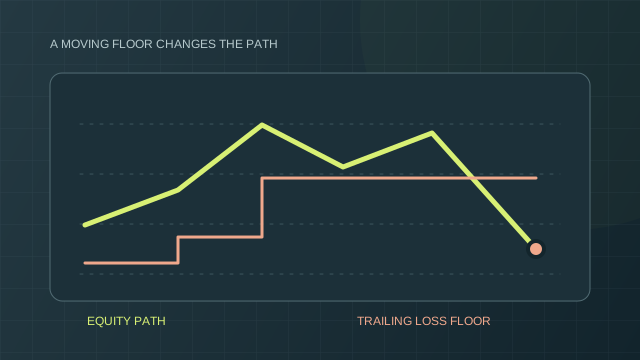
A loss floor is a boundary. Whether that boundary stays fixed or rises with gains can change the outcome before you close a trade.
Reviewed 2026-11-07 · Original hypothetical examples; no merchant preset or forecast.
Static: the boundary stays put
Use an original hypothetical $50,000 starting ledger and $2,000 allowance. A static floor stays at $48,000. If equity later reaches $52,000 and falls to $49,900, those supplied snapshots remain above that static floor.
Intraday equity trailing: an unrealized high can matter
Under a hypothetical intraday equity-trailing rule, the observed $52,000 high raises the floor to $50,000. Equity of $49,900 then sits $100 below it. An unchanged realized balance does not undo that mechanical breach.
Session-close trailing: updating and enforcement are separate
A floor can update from session-close balance and still be enforced during the session. Tradeify’s drawdown documentation explicitly makes that distinction. Do not read “end of day” as permission to cross the existing floor and recover before the close.
Try one path under multiple models
The default replay supplies the same snapshots to static, session-close and intraday models. It stops at the first terminal breach. Sparse observations cannot prove that no earlier unseen dip or high occurred. A real-plan replay also needs the provider’s exact session mapping, boundary, lock rules and correct phase.
Primary references
- Tradeify: trailing drawdown update and enforcement Read 2026-11-07
Worked examples are original illustrations under explicitly stated assumptions. Sources establish the referenced concepts or provider distinctions; they do not approve a purchase, establish suitability or verify a payout.