
Beginner guide / Futures first
Why is account profit different from a payout?
A payout can depend on qualifying days, consistency, caps, buffers and account review. Even a complete arithmetic check cannot approve a request.
Reviewed 2026-11-07 · Original hypothetical examples; no merchant preset or forecast.
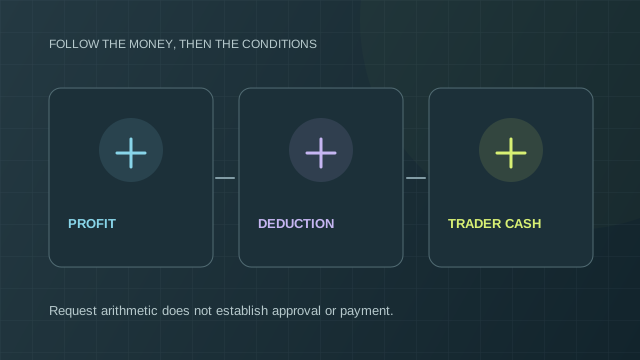
Begin with the deduction, then calculate the split
In our original hypothetical scenario, a ledger starts at $50,000 and balance/equity reach $52,500. A 50% cap on $2,500 total balance profit allows at most a $1,250 gross deduction, below a separate $2,500 fixed cap. At a 90% trader share, the estimate to the trader is $1,125 before payment fees and tax.
The account loses the gross amount in this example
Deducting $1,250 leaves equity of $51,250. Against an explicitly configured post-request floor of $50,100, remaining headroom is $1,150. The trader share and the account deduction are different numbers. If a provider defines either differently, this example’s formula does not apply.
Other conditions can still block the request
Our example supplies five qualifying days and an $800 best day out of $2,500 net cycle profit. That is a 32% share, fitting a hypothetical 40% limit. Four qualifying days would fail a five-day condition even though the balance was unchanged. Unknown conditions stay unresolved.
Use the exact path and purchase terms
Tradeify’s official policy distinguishes payout paths, purchase-date variants and add-ons. Its conditions must be read for the applicable account. The numbers above are editable illustrations, not a Tradeify preset. Actual review, account history, overlapping requests and payment fulfilment remain outside the arithmetic.
Primary references
- Tradeify: Select payout policy variants Read 2026-11-07
Worked examples are original illustrations under explicitly stated assumptions. Sources establish the referenced concepts or provider distinctions; they do not approve a purchase, establish suitability or verify a payout.