
Beginner guide / Futures first
What happens after you buy an evaluation?
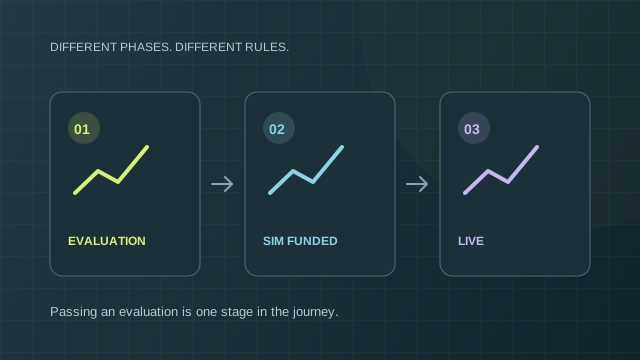
An evaluation purchase, a simulated funded account and a live trading account are separate stages. Read the rules for the stage you are actually buying.
Reviewed 2026-11-07 · Original hypothetical examples; no merchant preset or forecast.
First, identify what the fee buys
In this comparison, the initial product is a futures evaluation. Its advertised account size is a simulated notional label. The fee buys access under the provider’s conditions; it does not put that headline amount into a bank account you own.
Passing is a transition, not a cash withdrawal
A provider may move a trader to a separately governed simulated funded stage. For a concrete primary-source example, My Funded Futures describes evaluation, simulated funding and live stages separately in its Builder guide. The next ledger, restrictions and payout conditions need their own review.
A simple example
Suppose a hypothetical evaluation costs $150 and requires $3,000 of simulated profit. Paying $150 is a customer expense. Reaching the target is a performance condition. The $3,000 target is not automatically $3,000 payable to you. Activation charges, a new ledger, qualifying days and withdrawal rules may still matter.
The useful comparison
Compare evaluation fees with evaluation fees, and evaluation loss rules with evaluation loss rules. Then inspect what changes after passing. An unknown next-phase condition is a gap to resolve before purchasing, rather than a benefit.
Primary references
- My Funded Futures: Builder stage definitions Read 2026-11-07
Worked examples are original illustrations under explicitly stated assumptions. Sources establish the referenced concepts or provider distinctions; they do not approve a purchase, establish suitability or verify a payout.