
Beginner guide / Futures first
Does a “$50K account” give me $50K to lose?
Start with the allowed loss and the actual ledger balance. The advertised size does not answer either question on its own.
Reviewed 2026-11-07 · Original hypothetical examples; no merchant preset or forecast.
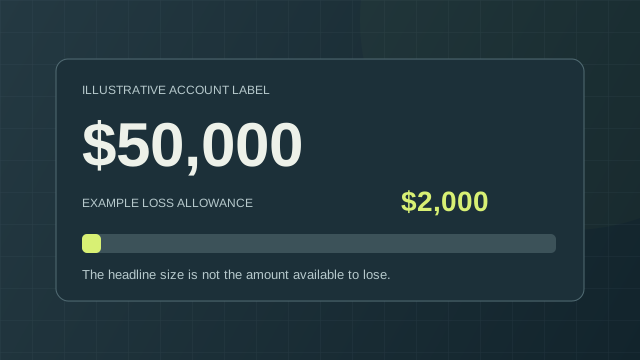
Three different numbers
In an original hypothetical example, an account is advertised as $50,000, starts its evaluation ledger at $50,000 and has a $2,000 maximum-loss allowance. Its initial floor is $48,000. The usable distance to that floor is $2,000, rather than the headline $50,000.
Open positions can use up that distance
If realized balance stays at $50,000 but an open position reduces equity to $49,000, the distance to that static $48,000 floor is $1,000. Equity includes unrealized gains and losses. A rule enforced against equity can trigger before a position is closed.
A new phase may use a different ledger
My Funded Futures’ Builder guide explicitly describes a simulated funded ledger starting at zero. That illustrates why the account’s advertised label cannot substitute for its actual starting balance. Hypothetically, a $0 ledger with a $2,000 allowance has an initial floor of −$2,000.
What to check on a plan
Identify the account phase, actual starting ledger, allowed loss, enforcement basis and whether the floor can trail upward. The tool’s zero-ledger example keeps a genuine zero rather than replacing it with the advertised size.
Primary references
- My Funded Futures: Builder stage definitions Read 2026-11-07
- Tradeify: trailing drawdown update and enforcement Read 2026-11-07
Worked examples are original illustrations under explicitly stated assumptions. Sources establish the referenced concepts or provider distinctions; they do not approve a purchase, establish suitability or verify a payout.